By Maggie Hughey AbuHaidar
ONE Wasatch would connect the 7 world-class ski
resorts in Park City, Little and Big Cottonwood
Canyons, on private land with private money, providing
access to 18,000 skiable acres, 750 named runs, and
100 lifts—with a single lift ticket. An interesting
new concept? “An interesting old concept,”
gently corrected Park City Mayor Jack Thomas, who
remembers the interconnect idea being kicked around as
long as forty years ago. One might wonder why, if
it’s such a good idea, it hasn’t been done yet.
Nathan Rafferty, President and CEO of Ski Utah,
assures me that the idea has “stayed around because
it’s a good one, but so complicated that no one’s
pushed it.” Until now.

While there seems to be no single reason why Ski Utah
finally decided to take the first step in creating a
Central Wasatch interconnect—if announcing the concept
can be considered a step—there are several reasons why
it may be the right time to do so. For one, all 7
resorts have agreed that it’s the right time. When
Ski Utah unveiled the concept in mid-March, the
general managers of Snowbird, Alta, Solitude,
Brighton, Canyons, Park City Mountain Resort (PCMR),
and Deer Valley were all there. Resorts that are in
direct competition with each other—including two that
are locked in a very public lawsuit—have joined forces
because the concept, as they see it, will be good for
the Utah ski industry as a whole.
Utah is, after all, in the ski and snowboard
business. The ski industry contributed $1.29 billion
to the state’s economy during the 2012-2013 season,
$1.076 billion of that coming from out-of-state and
international visitors. This represents about a 10%
increase over the 2010-2011 season. But the business
of attracting skiers to Utah remains a cutthroat one,
because the pool of people who ski is limited and our
main competitors are close-by. At the end of the day,
“it’s a business decision,” said Onno Wieringa,
General Manager of Alta, when asked about ONE Wasatch,
adding that, “As a ski area, I think we need to fight
for our industry. One part of that is to make more
people who ski come to Utah.”

Ski Utah thinks that the ONE Wasatch concept might do
just that. As Mr. Rafferty explains, “The ski
industry is not unlike other businesses, it must
constantly innovate and improve its product.” ONE
Wasatch could do both. With the addition of 4
inter-resort connections using 6 ski lifts, it would
create the largest ski complex in North America,
easily eclipsing Big Sky and Vail, at 5,532 and 5,289
acres, respectively. Even Whistler Blackcomb in
British Columbia, the current largest ski area in
North America, is relatively small at 8,171 acres.
Not only would ONE Wasatch become the largest in
North America, but it would stay that way. It is
Utah’s unique geography, with 7 resorts located in a
twenty-square-mile radius, that makes the interconnect
even possible. As Deer Valley General Manager Bob
Wheaton observed, “All of the resorts recognize that,
from a marketing standpoint, this is an opportunity
that no one else in North America can
duplicate.”
This opportunity positions Utah well in a market
where “the trend has been for larger resorts,”
observed Dave DeSeelhorst, General Manager of
Solitude. As lifts move more people more quickly,
grooming techniques reach more advanced terrain, skis
go faster, and clothing keeps people warmer, skiers
“can and want to cover more terrain in less days—more
terrain on their vacations.” Individual resorts face
pressure to expand to accommodate their skiers’
desires for more. The interconnect would allow the
Central Wasatch resorts to expand their offerings
without creating new terrain. In effect, ONE Wasatch
would offer Utah skiers a larger, virtual ski hill, by
eliminating resort boundaries. The days of spending
your whole family ski trip within the borders of one
ski resort would be over. Unlike creating one massive
resort, however, the character of each individual
resort would be preserved. People would still be able
to frequent their favorite mountains, towns, inns, and
watering holes, albeit with a little more daily
flexibility over the snow.
Utah ski resorts believe in their product and believe
that, once they get new skiers to try Utah skiing,
they will inevitably come back. ONE Wasatch is one
more reason for skiers to try us out. The concept is
thus intended to increase visibility and
marketability, which should, in turn, translate into
increased skier days and revenue. Utah currently
enjoys about 4 million skier visits per year. Mr.
Rafferty believes ONE Wasatch will attract national
and international attention sufficient to rival the
post-2002 Olympics bump, or about one million
additional annual skier visits over five years.
Others, including Mr. Wieringa, Mr. Wheaton, and Mr.
DeSeelhorst, are more conservative, hoping for a
10-15% increase over time. Even this more moderate
bump would not be insignificant. Based on recent
estimates of how much skiers spend on an average day,
an increase of just 10% could yield about $130,000,000
in additional annual revenue.
These skier days and revenue would be spread among 7
resorts and the many towns that provide pillows and
bar stools. And, for now, there seems to be plenty of
room for them. Bob Bonar, General Manager for
Snowbird, feels that the Central Wasatch has the ski
runs, hotels and restaurants to easily “go to five or
six million skier visits per year.” Mr. DeSeelhorst
and Mr. Wieringa agree that the resorts are all
operating under capacity. According to Bill Malone,
the President and CEO of the Park City Chamber of
Commerce and Visitors Bureau, there are also plenty of
empty beds in Park City, where lodging averages only
50% occupancy. Of course, it’s closer to 80% during
peak times, but that still leaves almost 5,000 empty
pillows during Christmas.
This increase is obviously supported by the 7
participating resorts, but also by those resorts that
are arguably marginalized by the concept. John
Loomis, Snowbasin Resort’s General Manager, looks at
ONE Wasatch as “just one more arrow in the quiver of
skiing in Utah.” If the concept makes someone come to
Utah who would ordinarily go to California or
Colorado, Mr. Loomis figures, they’ll come back and
the next time they might branch out. Surprisingly,
California seems to look at it much the same way for a
similar reason. Brook Taylor, from the California
Governor’s Office of Business and Economic
Development, wished Ski Utah “the best of luck,
especially if it encourages more international
tourism.” In other words, “a rising tide raises all
boats,” to borrow a well-worn phrase from Mr.
Loomis.

Not only does ONE Wasatch enjoy broad industry
support and seem to make business sense, but
technology has largely solved logistical issues
regarding revenue-sharing and ticketing that, at one
time, might have seemed prohibitive. By making it
possible to track a skier’s lift usage, technology
allows the resorts to determine what percentage of a
skier’s time is spent where and to share revenue
accordingly. According to Mr. DeSeelhorst, Brighton
and Solitude implemented this method with their Big
Cottonwood pass this year with much success. So, the
issue is not whether the 7 resorts can share revenue,
but rather, when they will adopt the system allowing
them to do so. Although Ski Utah has not determined
how the ONE Wasatch ticket will be priced, technology
can also help with cost-containment, by giving Ski
Utah pricing flexibility. That is, the ticket could
be priced for one resort, all 7, or anywhere
in-between. “The resorts could even sell a pass for
one lift,” Mr. Rafferty explained. “It’s that
scalable.” Regardless, Mr. Rafferty and Mr.
DeSeelhorst agreed that the resorts wouldn’t go to all
this effort and then price the experience so high that
it won’t get used.
Importantly, ONE Wasatch can also be accomplished on
private land with private money. That is, the
necessary ski lifts would be built by the resorts on
resort-owned property. Although this in no way
eliminates the need for permits and public input, it
considerably simplifies the process. In particular,
the three Park City resorts could be connected with as
few as three permit applications. As PCMR General
Manager Jenni Smith explained, these connections “will
be fairly straightforward. All are on private land
within the county or City boundaries and these
connections have been contemplated for some time.”
Even Mayor Thomas, who refused to weigh in on the
interconnect concept as a whole, admitted that “there
is support for a Park City interconnect. It can be
done responsibly, easily and without a dramatic
impact.”
Although the PCMR-Brighton and Solitude-Alta
connections are also on private land, they will
require additional review due to their locations.
While the PCMR-Brighton connection has raised little
concern, the Solitude-Alta connection through Grizzly
Gulch has been met with loud protest. Volume alone
will not win the argument, but Ski Utah will face
valid questions relating to watershed protection,
backcountry access, and transportation. The resorts
can cite water studies to prove that water impacts
have been and will be mitigated. They can argue that
backcountry skiers should be less obstructionist and
more willing to help develop long-term, sustainable,
backcountry access in Little Cottonwood Canyon. They
can point to on-going transportation planning by the
Mountain Accord to demonstrate that the issue is being
studied. However, whether they win these arguments
administratively may be less important than whether
they win them in the court of public opinion.

How ONE Wasatch as a whole may impact Park City is
also a valid concern. Surrounded as they are by
public land, Little and Big Cottonwood Canyons face
development restrictions not present in Park City. As
the primary bed-base for the concept, Park City may
need to grow to accommodate ONE Wasatch. Mr. Rafferty
viewed this dilemma as a “great problem to have.” Mr.
Malone and Ms. Smith both felt that Park City could
absorb the additional visitation, as it would occur
over time. Although the town may technically have
sufficient places to sleep and eat, and even more room
to grow in that regard, the roads are busy and the
parking lots are already full. Adding even more cars
to this congestion concerns many locals. Mayor
Thomas, Mr. Malone, and Ms. Smith all stressed that
careful transportation planning would be necessary,
perhaps in conjunction with the Mountain Accord.

As an active participant in the Mountain Accord, Ski
Utah is already engaged in long-term economic,
environmental, recreation, and transportation planning
for the central Wasatch Mountains. That the Mountain
Accord is already in place may very well be the last
reason why ONE Wasatch’s timing is right. ONE Wasatch
does not need a stamp of approval from the Mountain
Accord to proceed, but it should take advantage of the
opportunity the process offers—to bring all interested
players to the table—to work through the concept.
This sentiment was recently shared by Brad Petersen,
Director of the Utah Office of Outdoor Recreation, who
expressed concerns about transportion, backcountry
access and safety, and the future threat of continued
resort expansion. He encouraged Ski Utah to
facilitate the evaluation of ONE Wasatch through the
Mountain Accord. Done in that way, Mr. Petersen felt
“cautiously optimistic that . . . ONE Wasatch can
mitigate the concerns and build consensus for the
project.”
This cautious optimism is shared by many who are
excited by the possibilities that ONE Wasatch presents
but mindful of its potential difficulties. As Mr.
Bonar said, “ONE Wasatch is a great way to do
something really cool if it can be done in an
environmentally-friendly way.” Through the Mountain
Accord, open discussion, education, and perhaps a few,
good, long hikes through the proposed interconnect
areas, this “if” is attainable. Compromise is
possible and to be encouraged, by both sides, because
ONE Wasatch is an old idea whose time has finally
come.
Wasatch Talk
By Louis Arevalo
“Ski resort GM’s line up to back ‘One Wasatch”
was the headline of the
Salt Lake Tribune Wednesday March19, 2014. The
article referred to it as an historical event. Ski
Utah, the marketing group representing each of the
state’s resorts, announced the ski areas of the
central Wasatch had agreed to work on making
connections that would enable a person to visit all
seven resorts with one ticket. According to the One
Wasatch webpage these connections would be developed
on private land and that this concept could be a
reality within a few seasons. Further along the
article stated that this connected Wasatch would be
done with a collaborative effort presented through the
Mountain Accord process, of which Ski Utah is a
member. They conclude that when completed Utah could
then boast that its skiing had better access and more
options than the competition.
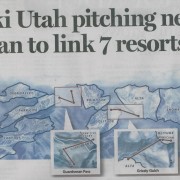
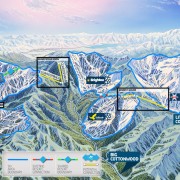
The map displayed on the One Wasatch website
highlighted areas of the possible connections. The
Monitors on the Park City Ridgeline between The
Canyons and Park City Mountain Resort, Park City to
Brighton over Guardsman’s Pass to Hidden Canyon, and
Twin Lakes Pass and Grizzly Gulch between Solitude and
Alta. These three areas are known in the local
community as being areas of backcountry use. With this
announcement Utah’s ski and snowboard industry had
painted a bright picture of what their future might
be, but what did others think?
“Who wants this expansion?” Salt Lake resident,
physician, and photographer, Howie Garber asked. For
the past 30 years he’s been fighting for local
conservation and has authored the book, “Utah’s
Wasatch Range: Four Season Refuge”, that makes a
compelling case for preserving the very mountains the
One Wasatch Concept would impact. I’d stopped by his
house to get a signed copy. Sighting the Wasatch
Tomorrow study, conducted between 2009-2010, Howie
continued, “94% of the 16,000 citizens surveyed
supported limiting resort expansions… When do local
populations get an opportunity to determine how much
takes place in their backyard? They’re building
something for the sake of the tourists!” Howie was
obviously concerned. He’s witnessed backcountry
terrain in the mountains next to the Salt Lake Valley
slowly gobbled up by ski area expansions; The Supreme
lift at Alta, Honeycomb Return at Solitude, and Snake
Creek and Great Western lifts at Brighton. His concern
also carries over to the watershed, environment,
development, lift prices, increased traffic and global
warming. “40 years from now winters in Utah are going
to look entirely different,” referring to the
predictions that the winter snowlines in the Wasatch
will retreat to higher elevations.

Echoing Howie’s concern is Carl Fisher, executive
director of Save Our Canyons (SOC), a community driven
conservation group whose focus is on preserving the
Wasatch Mountains, who told me that SOC was adamantly
opposed to the One Wasatch Concept. He feels any
further expansion would be a compromise on top of the
compromises SOC has already made with the resorts.
Save Our Canyons was actually created by locals who
were concerned with overdevelopment of the Wasatch in
response to the building of Snowbird Ski Resort in
1972.
A native of the Wasatch Range, Carl has been at SOC
since 2001. He carries a spark in his eyes that is
obviously fed by passion for his work. “We’ve received
over a thousand comments since One Wasatch was
announced,” Carl energetically continued. “Even
out-of-state visitors say it will ruin why they come;
which is easily accessed resorts and easily accessed
backcountry.” Carl feels the local ski area’s appetite
for expansion will never be sated and that this latest
campaign is ill conceived. “One Wasatch is simply a
talking point to help Utah compete with Colorado,
California and international destinations.” He
followed this up with some statistics. Skier days in
Utah are on the rise mainly through backcountry use.
SnowSport Industries of America puts backcountry users
at over 5 million, signaling to Carl that Ski Utah is
stepping on the toes of the out-of-bounds skiers with
this move. That brought me back to Howie’s initial
question, “Who really wants this?”

If Save Our Canyons could put a price tag on
dispersed recreation then maybe more people would get
on board with preserving the open spaces. To get more
information on users of the Wasatch Mountains, SOC in
partnership with Salt Lake City and the US Forest
Service is rolling out dispersed recreation surveys
this spring. They are hoping to use the data to gain a
better understanding of the economic value of this
natural resource. When asked about the links taking
place on private land Carl responded that until we
could see actual lift alignments there was not much to
say. He did say that even if the towers were on
private land, public lands would come into play, as
well as the watershed, and the environment. However,
Carl does hold some optimism that the concept will be
run through the Mountain Accord of which he is an
executive board member. “You should talk to Laynee
Jones.”
“When are you going to write an article about the
Mountain Accord?” Program director Laynee Jones had
caught me off guard. “We have the decision makers at
the table (cities, government entities, businesses,
private sector and the public). It’s a real powerhouse
and they’re here to find solutions and willing to
compromise. This has never been seen before.”
She had a point. A civil engineer with experience in
transportation and environmental consulting, Laynee
had moved to Utah to live in the mountains. Being an
active member of the outdoor community she’s focused
her work on integrating manmade development with the
natural world. Through the Mountain Accord Laynee sees
an opportunity to do something remarkable that will
preserve the Wasatch for generations to come. I didn’t
have an answer for her at the time, but maybe “now” is
appropriate.

What is the Mountain Accord? In brief it’s a
progressive approach to develop a blueprint for future
planning of the Central Wasatch Mountains of Utah.
Using findings from previous studies the Mountain
Accord is currently focused on developing guidelines
for the area east from the Salt Lake International
Airport to Summit and Wasatch Counties and from
Interstate 80 south to the Little Cottonwood Canyon
Divide. One key element that should not be overlooked
is that this whole process is open to the public.
Anyone may submit comments in writing or online,
review the group’s documents and attend stakeholder
meetings.
Laynee explained that currently the four systems
groups of transportation, environmental, economic and
recreation are independently gathering
best-course-of-action ideas for their individual sets
for the next 150 years in the study area. This August
all groups will be presenting their idealized
scenarios. As Laynee described it they will
figuratively be laying plans one on top of each other
to discover how closely or how far apart each plan
lines up. She predicts there will be huge areas of
agreement and small areas of disagreement.
When I asked Laynee about One Wasatch she responded
that the concept would have to be presented to
Mountain Accord through one of the groups. She then
clarified that there is agreement from all parties and
entities involved with the Mountain Accord on
preserving the Wasatch with an emphasis on the
transportation issues. In fact everyone I spoke with
agreed that when it came to transportation there was
room for improvement. “This is an area where we can’t
afford to do nothing.”
My next conversation was with Black Diamond
Equipment’s CEO and Mountain Accord executive board
member, Peter Metcalf. He had multiple perspectives on
the One Wasatch Concept. Personally he is against ski
area expansion and, like Carl, wants a better
understanding of the value of the surrounding open
spaces. In the past 25 years, since bringing Black
Diamond Equipment to Salt Lake, the expansion of ski
resorts within the Wasatch Mountains has been a
constant fight. The availability of inbounds and
out-of-bounds skiing was one of the initial reasons
the company chose the Wasatch. His second perspective
comes from his professional experience. He considers
the One Wasatch Concept a marketing move to attract
more skiers to the state and understands Ski Utah’s
desire to one-up the competition, but he doesn’t buy
it. “Who’s really going to ski all resorts in one day
and is it even possible without sitting on lifts all
day long AND doing mediocre traverses?” Peter
continued by reflecting items I’d heard from Carl,
Howie and Laynee. Winter backcountry use throughout
the Wasatch is growing as well as summer use. These
segments of users (hikers, bikers, campers, climbers)
have to be considered in the overall plan.

Like Carl, Peter was also hopeful there could be a
positive outcome. He counseled to move forward slowly
and get the community involved. And if the resorts
really want to pursue these connections he had some
ideas. In the interest of finally putting an end to
ski resort expansion he has come up with a scenario
dubbed the “Grand Bargain.”
“To me that grand bargain would be defined
as approval of the interconnect as part of a much
larger Wasatch agreement that would include the
following: a route that was the least impactful to the
existing Wasatch backcountry ski experience, minimal
& defined prepared piste on the sides of the
lifts, guaranteed access to backcountry skiers of the
linked zones, full support of the expanded Matheson
Wasatch Wilderness Bill, a giving up of all future
development rights (assign to Utah or Summit County
open lands) via conservation easements on all private
lands surrounding the new lifts, binding agreements
between the ski areas and the forest service to never
expand the ski areas beyond their current boundaries,
and an abandonment by Snowbird of their desire to
build a tram from the top of Hidden Peak to the top of
American Fork Twin Peaks.”
Peter had given me a lot to consider. I needed to
follow up with Carl.
Carl wasn’t super enthused about Peter’s “grand
bargain” idea and left me with this statement. “What
we have today (in the Wasatch) can’t be found anywhere
else in the world. It’s what puts Utah on the map.
Losing it would be to the detriment not only of the
ski areas but the greater Utah economy.”
Eventually I was back where I began, sitting in
Howie’s living room asking questions.
Over the next 30-40 years the population of Utah is
predicted to double and with it so will the pressure
on the Wasatch Mountains. Having the ski industry
focused on growing their numbers while the community
faces the issues of clean air, growing populations,
transportation, watershed, environment and
development is all part of the picture. Who wants
One Wasatch? I’m sure tons of people who are
connected to the ski tourism industry and love
skiing at Utah’s resorts. Who doesn’t want this?
Maybe people who find refuge in this small gem of a
range. And I’m certain there are people who want
both. Howie broke the heaviness in the air.
“The bottom line, Louie, is that it’s about the
preservation of powder skiing, which I truly believe
is a dwindling natural resource!” We both laughed,
but he was serious. For him it’s powder, for someone
else it could be wildflowers and others, the value
they find in open space. For Ski Utah it’s sharing
our world-class terrain. If we can agree that
everyone is passionate about preserving the Wasatch
then the only question we need to ask is how can we
do that best?


 Almost 30 years ago, when I decided to make Utah my
home, I was struck by certain similarities between the
Wasatch mountains and “Portes du Soleil,” a major ski
interconnect weaved around Morzine, the French ski town
where I grew up in the Alps. Even though it boasts more
than 200 ski lifts, like Courchevel and the Three
Valleys, this huge area was never planned to be
interconnected.
Almost 30 years ago, when I decided to make Utah my
home, I was struck by certain similarities between the
Wasatch mountains and “Portes du Soleil,” a major ski
interconnect weaved around Morzine, the French ski town
where I grew up in the Alps. Even though it boasts more
than 200 ski lifts, like Courchevel and the Three
Valleys, this huge area was never planned to be
interconnected.